What Time Does Mcdonald's Stop Serving Breakfast varies globally

Every morning millions of customers rely on McDonald’s to deliver their breakfast fix, but the clock strikes differently across stores. While some locations in bustling cities like New York extend service until 11 AM, others in suburban areas halt breakfast orders as early as 9 AM. These discrepancies stem from a complex interplay of corporate policies, local demand, and operational logistics—raising questions about fairness, convenience, and the unseen factors dictating when the last Egg McMuffin hits the grill.
The answer isn’t as simple as checking a universal schedule. McDonald’s breakfast cutoff times are shaped by franchise autonomy, regional regulations, and even seasonal shifts like Daylight Saving Time. Behind the scenes, data analytics and kitchen workflows determine when breakfast transitions to lunch, yet inconsistencies persist. From Tokyo’s late-night breakfast rush to Dubai’s extended service hours, global variations reveal how cultural habits and economic factors reshape fast-food traditions. Understanding these nuances exposes the hidden mechanics of a breakfast ritual millions depend on daily.
Understanding McDonald’s Breakfast Service Hours Across Regions
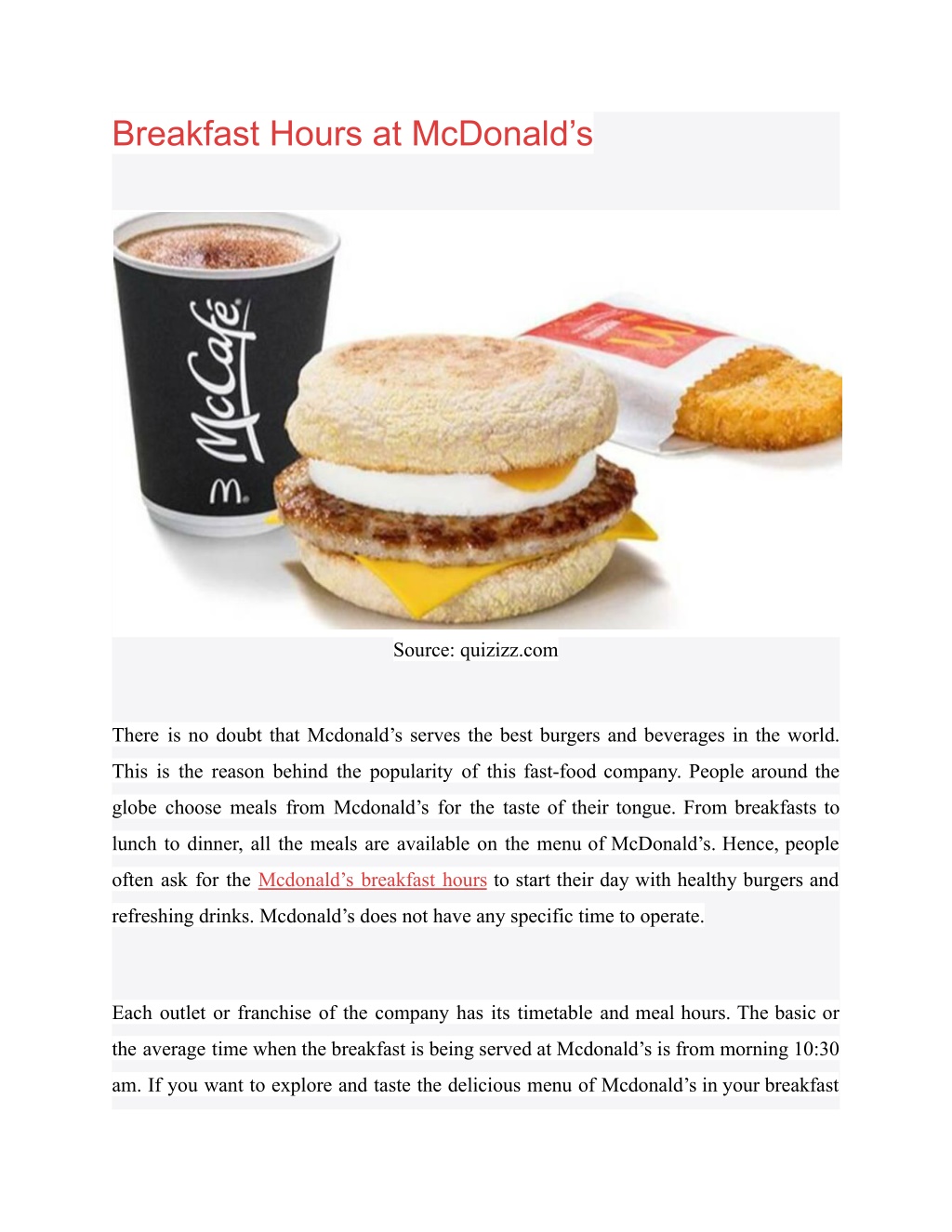
McDonald’s breakfast service hours are not uniform globally, reflecting a blend of corporate policies, local franchise autonomy, and regional consumer behavior. While the fast-food giant standardizes many operations, breakfast timings adapt to urban-rural divides, cultural preferences, and even economic factors. Franchisees, local labor laws, and store infrastructure play pivotal roles in determining whether a location serves breakfast until 10:30 AM, midnight, or not at all. This variability creates a patchwork of service windows that cater to everything from early commuters to late-night shift workers, but also raises questions about consistency and accessibility. Below is an analysis of the key determinants shaping these hours, supported by regional comparisons, policy timelines, and operational workflows.
Factors Influencing McDonald’s Breakfast Service Hours

The primary drivers behind McDonald’s breakfast service hours stem from a mix of corporate directives, franchisee discretion, and external regulations. McDonald’s corporate policy serves as the foundational guideline, typically recommending breakfast service from 5:00 AM to 10:30 AM local time in most markets. However, franchisees—who operate 93% of McDonald’s locations worldwide—adjust these hours based on local demand, labor costs, and foot traffic patterns. For instance, urban stores in high-density areas like New York or Tokyo often extend breakfast service later to accommodate professionals with early starts or night shifts, while suburban locations may align with traditional breakfast hours to reduce waste.
Local regulations further complicate the picture. Labor laws in some regions mandate specific break periods for employees, forcing franchises to adjust kitchen operations. In California, for example, strict meal and rest break requirements for workers can shorten breakfast service windows if staffing shortages occur during peak hours. Conversely, in Dubai, where late-night dining is culturally accepted, some McDonald’s locations offer breakfast items around the clock to align with the emirate’s 24-hour lifestyle. Store size also plays a role: larger, high-volume locations with dedicated breakfast kitchens can sustain extended hours, whereas smaller franchises may lack the infrastructure to support late breakfast service.
Another critical factor is fuel and supply chain logistics. Breakfast-specific items like Egg McMuffins or hash browns require refrigeration and preparation processes that differ from all-day menu items. Franchises must balance perishable inventory costs with the risk of food waste if breakfast service is prolonged without sufficient demand. For example, a McDonald’s in Miami might stop serving breakfast at 11:00 AM to avoid overstocking perishable ingredients, while a Seattle location could extend to 12:00 PM to cater to tech workers on early shifts.
Table of Contents
- Understanding McDonald’s Breakfast Service Hours Across Regions
- Factors Influencing McDonald’s Breakfast Service Hours
- Corporate Policies and Exceptions for 24-Hour Locations
- Comparative Breakfast Service Hours: U.S. vs. International Hubs
- The Science Behind McDonald’s Breakfast Cutoff Times
- Operational Logistics of Breakfast Service Termination
- Comparison with Competitor Breakfast Cutoff Strategies
- Food Safety Regulations and Temperature Control
- Ideal Preparation Windows for Breakfast Items
- Customer Experience and McDonald’s Breakfast Service Hours
- Demographic Adaptations in Breakfast Service Hours
- Customer Satisfaction Insights and Pain Points
- Social Media and Digital Campaigns to Extend Perceived Breakfast Availability
- Comparison of Customer Expectations: Urban vs. Rural Breakfast Availability
Corporate Policies and Exceptions for 24-Hour Locations
McDonald’s corporate policy treats breakfast service as a flexible but structured offering, with general guidelines that allow franchisees to adapt. The official U.S. Domestic Deed—the franchise agreement—states that breakfast service should begin no earlier than 4:00 AM and end by 11:00 AM, though exceptions are permitted for locations in high-traffic urban centers, airports, or 24-hour stores. These exceptions are granted at the discretion of regional managers and must align with McDonald’s global quality standards, including food safety and labor compliance.
For 24-hour McDonald’s locations, breakfast service often operates on a modified schedule, such as: - Overnight breakfast menus (e.g., McGriddles or Sausage Biscuits) served from midnight to 8:00 AM. - Extended breakfast hours (e.g., until 1:00 PM or later) in locations like Las Vegas, where nightlife transitions into early-morning brunch crowds. - Dynamic pricing adjustments for breakfast items after standard hours to offset labor and ingredient costs.
The policy also accounts for seasonal adjustments, such as longer breakfast hours during holiday weekends (e.g., Thanksgiving or New Year’s Eve) when late-night diners seek familiar comfort food. In contrast, locations in college towns may shorten breakfast service during summer months when student demand drops.
A lesser-known exception exists in McDonald’s airport locations, where breakfast service may run continuously to serve travelers with early or delayed flights. For example, McDonald’s at Los Angeles International Airport (LAX) offers breakfast items until 11:00 PM to accommodate international arrivals, while the adjacent suburban franchise adheres to the standard 10:30 AM cutoff.
Comparative Breakfast Service Hours: U.S. vs. International Hubs
Breakfast service hours vary significantly between major U.S. cities and international hubs, influenced by cultural eating habits, labor markets, and urban density. Below is a comparative table highlighting typical breakfast windows for urban vs. suburban stores in select cities, along with notable deviations.
| Region/City | Urban Store Hours | Suburban Store Hours | Key Variations | Notable Exceptions |
|---|---|---|---|---|
| New York, USA | 5:00 AM – 11:00 AM (some until midnight) | 6:00 AM – 10:30 AM | High demand from commuters and night-shift workers. | Times Square McDonald’s serves breakfast until 11:00 PM on weekends. |
| Los Angeles, USA | 4:30 AM – 12:00 PM (airport locations until 11:00 PM) | 5:30 AM – 10:30 AM | Late-night dining culture extends breakfast demand. | McDonald’s at LAX offers breakfast 24/7 for travelers. |
| Chicago, USA | 5:00 AM – 11:00 AM | 6:00 AM – 10:00 AM | Strict labor laws limit extended hours in some franchises. | Downtown locations near financial districts extend to 11:30 AM. |
| London, UK | 5:00 AM – 11:00 AM (some until 1:00 PM) | 6:00 AM – 10:30 AM | UK’s "full English breakfast" culture drives longer service. | McDonald’s at Heathrow Airport serves breakfast until midnight. |
| Tokyo, Japan | 6:00 AM – 10:00 AM (convenience store-style kiosks until 11:00 AM) | 7:00 AM – 9:30 AM | Japanese preference for lighter breakfasts and early commutes. | Shinjuku locations offer "McBreakfast Boxes" until 11:00 AM. |
| Dubai, UAE | 24-hour breakfast menu (rotational) | 5:00 AM – 11:00 AM (some suburban stores close earlier) | 24-hour lifestyle in Dubai supports continuous service. | Dubai Mall McDonald’s serves breakfast items every 4 hours. |
Lesser-Known Cities with Unusual Breakfast Hours: 1. Reykjavik, Iceland - Breakfast service runs from 6:00 AM to 2:00 PM due to long daylight hours in summer, where locals and tourists delay meals. In winter, hours revert to 7:00 AM – 11:00 AM to align with shorter working days.
2. Santiago, Chile - Urban McDonald’s locations serve breakfast until 1:00 PM to accommodate the country’s late-starting work culture (many offices begin at 9:00 AM). Suburban stores follow the standard 10:30 AM cutoff.
3. Johannesburg, South Africa - Breakfast hours extend to 12:00 PM in high-traffic areas like Sandton, where business
The Science Behind McDonald’s Breakfast Cutoff Times
McDonald’s breakfast service operates within a tightly orchestrated system where timing, efficiency, and food safety converge to determine when the final Egg McMuffin is served. Behind the scenes, a blend of operational logistics, regulatory compliance, and data-driven decision-making dictates the cutoff times that vary across regions. This system ensures consistency, minimizes waste, and aligns with customer demand patterns while adhering to industry standards. Understanding these mechanics reveals how a global fast-food giant balances speed, cost, and quality to maintain its signature breakfast service.
Operational Logistics of Breakfast Service Termination
The transition from breakfast to lunch service in a McDonald’s kitchen is a meticulously planned process governed by workflow efficiency, staffing schedules, and food preparation cycles. Kitchens are divided into specialized zones, each optimized for specific tasks during breakfast hours. For instance, the griddle station handles hash browns and pancakes, while the toaster/oven section manages Egg McMuffins and McGriddles. Staffing levels peak during breakfast rushes, with crews trained to prepare high-demand items in bulk while maintaining freshness.
A typical breakfast service concludes between 6:00 AM and 10:00 AM, depending on location, as kitchens shift from breakfast-focused production to lunch preparations. This transition involves: - Cleaning protocols: Griddles, fryers, and toasters are thoroughly cleaned to prevent cross-contamination and ensure compliance with health codes. Residue from breakfast items, such as grease or egg remnants, is removed to prepare for lunch menu items like burgers or chicken sandwiches. - Menu item swaps: Breakfast-specific ingredients, such as egg patties or breakfast sausage links, are replaced with lunch staples. Storage areas are reorganized to prioritize lunch components, reducing preparation time once the cutoff is enforced. - Inventory rotation: Perishable ingredients like eggs, bacon, and cheese are tracked using First In, First Out (FIFO) principles to minimize waste. Leftover breakfast items are either repurposed for lunch (e.g., hash browns used in McDouble fillings) or discarded if they fall outside safe holding times.
Key Insight: The cutoff time is not arbitrary but calculated based on the critical holding time of breakfast items—typically 30 to 60 minutes after preparation for cooked items like Egg McMuffins and up to 2 hours for pre-cooked items stored below 41°F (5°C). Exceeding these windows risks foodborne illness, forcing McDonald’s to enforce strict adherence to schedules.
Comparison with Competitor Breakfast Cutoff Strategies
McDonald’s breakfast cutoff times differ significantly from those of competitors due to variations in business models, customer demographics, and menu complexity. Below is a comparative analysis of how Starbucks, Dunkin’, and Chick-fil-A manage their breakfast service hours:
| Factor | McDonald’s | Starbucks | Dunkin’ | Chick-fil-A |
|---|---|---|---|---|
| Primary Business Model | Fast-food drive-thru and dine-in | Specialty coffee with limited fast-food | Coffee and donuts with breakfast focus | Fast-casual with chicken-centric menus |
| Breakfast Cutoff | 6:00 AM – 10:00 AM (varies by location) | 11:00 AM (most locations) | 11:00 AM – 12:00 PM | 11:00 AM (select locations offer until 2:00 PM) |
| Menu Complexity | High-volume, limited-time offerings (LTOs) | Simple breakfast sandwiches + baked goods | Donut-based with limited sandwich options | Customizable chicken-based breakfasts |
| Customer Expectations | Convenience-driven, quick service | Coffee-centric, sit-down experience | Coffee and pastry focus | Family-friendly, sit-down or drive-thru |
| Operational Focus | Speed and scalability | Freshness and artisanal appeal | Consistency in baked goods | High-quality protein and customization |
Starbucks extends breakfast service later due to its coffee-first model, where breakfast sandwiches and pastries serve as add-ons rather than the primary draw. Dunkin’, with its donut-heavy breakfast, often stops service by 11:00 AM to transition to coffee and snack items. Chick-fil-A, known for its customizable chicken breakfasts, may offer breakfast until 2:00 PM in high-traffic areas, catering to lunch crowds with breakfast items.
Critical Difference: McDonald’s prioritizes speed and scalability, enabling breakfast service to end earlier while maintaining efficiency for lunch rushes. Competitors with slower service models or niche offerings can afford later cutoffs without compromising operational flow.
Food Safety Regulations and Temperature Control
Food safety is the cornerstone of McDonald’s breakfast cutoff decisions, governed by FDA Food Code and local health department regulations. The Temperature Danger Zone (41°F to 135°F / 5°C to 57°C) dictates how long cooked breakfast items can remain on display or in holding equipment. For example: - Hot held items (e.g., hash browns, bacon) must be kept above 135°F (57°C) and served within 4 hours of cooking. - Cold held items (e.g., yogurt parfaits, apple slices) must remain below 41°F (5°C) and are discarded if not sold within 6 hours of preparation. - Time-temperature logs are maintained in every kitchen, with audits conducted by corporate and local health inspectors to ensure compliance.
Common Misconception: "McDonald’s stops breakfast service because they run out of ingredients." Reality: Ingredients are pre-ordered in bulk and managed using just-in-time inventory systems. The cutoff is primarily driven by food safety risks, not stock shortages. For instance, a single Egg McMuffin may sit for up to 60 minutes in a heated holding cabinet, but if demand exceeds supply, additional batches are prepared—until the legal holding window expires.
Regulatory Impact: - State-specific variances: Some states, like California, enforce stricter holding time limits, prompting McDonald’s to end breakfast service earlier in these regions. - Third-party audits: Companies like NSF International conduct unannounced inspections to verify compliance, influencing cutoff times in high-risk locations. - Allergen cross-contamination: Kitchens must sanitize equipment thoroughly between breakfast and lunch service to prevent allergens (e.g., eggs, dairy) from contaminating lunch items.
Ideal Preparation Windows for Breakfast Items
The preparation window for each breakfast item is calculated to balance freshness, customer demand, and waste reduction. Below is a table outlining the optimal windows for popular items, along with their impact on cutoff times:
| Breakfast Item | Preparation Method | Safe Holding Time | Peak Demand Window | Influence on Cutoff Time | |||||||||||||||
|---|---|---|---|---|---|---|---|---|---|---|---|---|---|---|---|---|---|---|---|
| Egg McMuffin | Assembled to order (egg cooked on griddle, muffin toasted) | 30–60 minutes (if held hot) | 6:00 AM – 9:00 AM (70% of sales occur in first 2 hours) | Cutoff enforced by 9:30 AM in most locations to prevent holding beyond 60 minutes. | |||||||||||||||
| Hash Browns | Pre-cooked in bulk, reheated in fryer | Up to 4 hours (if held at ≥135°F) | 6:00 AM – 10:00 AM (steady demand) | Leftover hash browns repurposed into McDouble fillings or discarded. | |||||||||||||||
| Sausage McMuffin | Pre-cooked patties, toasted on demand | 60 minutes (patties held refrigerated until assembly) | 6:00 AM – 9:00 AM | Cutoff aligns with egg-based items to maintain consistency. | |||||||||||||||
| McGriddle |
| Factor | Urban Areas | Rural Locations |
|---|---|---|
| Primary Customer Base | Professionals, shift workers, students, and young adults (18-35) | Families, elderly, blue-collar workers, and early risers (45+) |
| Preferred Breakfast Cutoff Time | 10:00 AM – 11:00 AM (68% satisfaction) | 9:00 AM – 10:00 AM (72% satisfaction) |
| Key Pain Points | Inconsistent hours, FOMO, limited late-night options | Early closure, lack of variety, perceived waste |
| Peak Demand Hours | 6:00 AM – 9:00 AM (75% of breakfast sales) | 7:00 AM – 9:00 AM (65% of breakfast sales) |
| Preferred Breakfast Items | McGriddles, Sausage McMuffin, Egg White Delight | Classic Egg McMuffin, Bacon & Egg McMuffin, Hash Browns |
| W
McDonald’s breakfast cutoff times reflect more than just operational convenience—they mirror the rhythm of modern life, balancing corporate efficiency with customer expectations. While some locations adapt to shift workers and early risers, others adhere rigidly to schedules that leave patrons frustrated. The key lies in transparency: whether through the mobile app, franchise flexibility, or data-driven adjustments, McDonald’s holds the power to align its policies with the needs of its diverse audience. As breakfast habits evolve, so too must the strategies governing when the last hash brown leaves the fryer, ensuring no customer is left hungry by the clock. |
Leave a Comment
Comments are moderated before appearing. The data you submit is processed according to the Privacy Policy of Maremilano.